India is one of the world’s most diverse travel destinations, offering everything from historic monuments and colourful cities to mountain landscapes, beaches, wildlife reserves and spiritual destinations. With so many places to explore, choosing the right transportation can make a major difference to your travel experience.
For many visitors, renting a car provides a comfortable and flexible way to explore India. Whether you are planning a short city trip, a Golden Triangle journey, a Rajasthan road trip or a multi-week holiday, you can find different car rental options based on your budget, itinerary and travel preferences.
If you are wondering how to rent a car in India, the first thing to understand is that there are several different rental models. You can choose a self-drive vehicle, hire a car with a professional driver, arrange an airport transfer or book a private vehicle for a multi-day tour.
Rental prices also vary considerably depending on the vehicle, city, season, distance and services included. Current 2026 market guides show self-drive cars ranging from roughly ₹1,100–₹2,500 or more per day for common vehicle categories, while chauffeur-driven vehicles can range from around ₹2,000 to ₹7,500+ per day depending on the vehicle and itinerary. These are planning ranges rather than fixed nationwide tariffs.
This guide explains how to rent a car in India, what it costs, which option may suit your trip, what documents you may need and how to avoid common rental problems.
Why Rent a Car in India?
India has an extensive railway, bus and domestic flight network, but there are situations where travelling by car can be more convenient.
A private vehicle gives you greater flexibility over your itinerary. Instead of travelling according to a fixed train or bus timetable, you can choose your departure time and make stops along the way.
Car rental can be particularly useful for:
- Multi-city holidays
- Family vacations
- Couple trips
- Rajasthan tours
- Golden Triangle tours
- Religious and pilgrimage journeys
- Airport transfers
- Local sightseeing
- Long-distance road trips
- Business travel
- Group tours
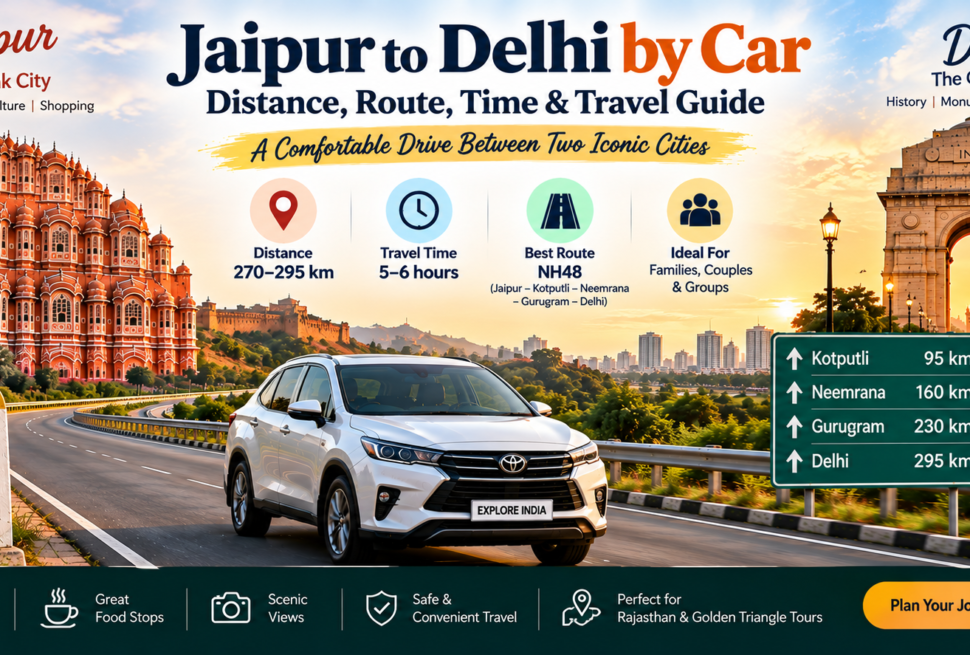
For example, someone travelling from Delhi to Agra and Jaipur may find a private car convenient because the vehicle can remain available throughout the journey.
Similarly, travellers exploring Rajasthan may prefer a car because popular destinations such as Jaipur, Jodhpur, Udaipur, Pushkar and Jaisalmer are spread across a large area.
Types of Car Rental in India
Before learning how to rent a car in India, it is important to understand the main rental options.
1. Self-Drive Car Rental
Self-drive rental means you hire a vehicle and drive it yourself.
This option is suitable for travellers who want complete independence and are comfortable driving in Indian traffic.
Self-drive services are available in several Indian cities, with prices depending on the vehicle, rental duration, location and demand. Some current 2026 rental platforms advertise entry-level hatchbacks from around ₹1,100 per day, while larger vehicles can cost considerably more. Fuel, tolls and some other expenses may be charged separately.
Before booking a self-drive vehicle, check:
- Driver eligibility
- Licence requirements
- Security deposit
- Insurance coverage
- Fuel policy
- Mileage restrictions
- Vehicle pickup location
- Return conditions
- Damage policy
- Cancellation rules
2. Chauffeur-Driven Car Rental
A chauffeur-driven rental includes a professional driver with the vehicle.
This is a common option for tourists travelling around India, particularly for multi-city journeys.
Instead of concentrating on traffic and navigation, you can sit back and enjoy the journey.
Depending on the rental company, the price may be calculated as:
- A daily package
- Per-kilometre rate
- Fixed route price
- Multi-day tour package
- Local sightseeing package
Current 2026 market examples show chauffeur-driven sedan and SUV prices varying widely according to route and inclusions, with Delhi-based tourist vehicles often quoted from around ₹2,800–₹7,500+ per day for common categories.
Always ask exactly what is included before comparing prices.
3. Airport Car Rental
Airport transfers are another convenient option.
You can pre-book a car to pick you up from the airport and take you directly to your hotel or another destination.
Airport transfers can be particularly useful if:
- You arrive late at night
- You have heavy luggage
- You are travelling with children
- You are visiting India for the first time
- You do not know the local transportation system
- You have a tight schedule
4. Multi-Day Car Rental
If you are travelling across several cities, you can hire a car for the entire itinerary.
For example:
Delhi → Agra → Jaipur → Jodhpur → Udaipur
A multi-day private vehicle can provide more flexibility than booking separate taxis for every destination.
Before booking, confirm whether the quotation includes driver accommodation, fuel, tolls, parking, interstate taxes and other expenses.
How Much Does It Cost to Rent a Car in India?
There is no single nationwide price for car rental in India.
The cost depends on:
- Car category
- Rental duration
- Travel distance
- Pickup city
- Destination
- Season
- Demand
- Driver requirement
- Fuel policy
- Toll charges
- Parking
- Interstate taxes
- Additional kilometres
As a broad 2026 planning reference, current market data places self-drive rentals around ₹1,100–₹2,500+ per day for common hatchbacks and sedans, with SUVs often starting higher. Some live marketplace data in September 2026 shows a national median self-drive daily base rate around ₹3,250 across its tracked listings, illustrating how much prices can vary by city and vehicle.
For chauffeur-driven travel, current Delhi/North India tourist-vehicle examples range from approximately ₹2,800–₹4,000 for smaller sedans and around ₹5,500–₹7,500 for premium MPVs such as an Innova Crysta, although actual quotations vary by route and inclusions.
Approximate Planning Range
| Vehicle Type | Self-Drive Approx. | Chauffeur-Driven Approx. |
|---|---|---|
| Hatchback | ₹1,100–₹2,500/day | ₹2,000–₹3,500/day |
| Sedan | ₹1,600–₹4,000/day | ₹2,500–₹5,000/day |
| SUV | ₹2,200–₹5,000+/day | ₹3,500–₹7,500+/day |
| Premium SUV/MPV | ₹4,000–₹8,000+ | ₹5,500–₹10,000+ |
| Luxury Vehicle | Varies considerably | ₹10,000+ |
These figures are indicative planning ranges, not fixed tariffs. Your final quotation can be higher or lower depending on location, season, vehicle availability and inclusions.
What Is Usually Included in the Rental Price?
This is one of the most important questions to ask before booking.
Depending on the service, the rental price may include:
- Vehicle
- Driver
- Fuel
- Driver allowance
- Basic insurance
- Limited kilometres
- Airport pickup
- Local sightseeing
But some companies charge separately for:
- Fuel
- Toll taxes
- Parking
- Interstate permits
- State taxes
- Additional kilometres
- Driver accommodation
- Night charges
- Extra waiting time
Never assume that a low advertised price represents the final amount.
Step-by-Step: How to Rent a Car in India
If you are renting a car for the first time, follow these steps.
Step 1: Decide Where You Want to Travel
Start by preparing your itinerary.
For example:
Day 1–2: Delhi
Day 3: Agra
Day 4–6: Jaipur
Day 7–9: Jodhpur
Day 10–11: Udaipur
Once you know your route, it becomes easier to decide what type of rental you need.
Step 2: Decide Between Self-Drive and Chauffeur
Ask yourself how comfortable you are driving in India.
If you are an experienced driver familiar with Indian road conditions, self-drive may provide greater independence.
If you are visiting India for the first time or travelling across several cities, a chauffeur-driven car may simplify navigation, parking and long-distance travel.
Step 3: Choose the Right Vehicle
Choose your vehicle according to the number of passengers and luggage.
For two travellers with small bags, a sedan may be sufficient.
For a family with several suitcases, an SUV or MPV may be more comfortable.
For larger groups, a Tempo Traveller or similar vehicle may be more practical.
Do not choose a vehicle based only on the lowest price.
Step 4: Compare Several Quotations
Request quotations from more than one provider.
Ask each company for:
- Vehicle type
- Model or equivalent
- Rental duration
- Total kilometres
- Fuel policy
- Driver charges
- Toll charges
- Parking charges
- Taxes
- Security deposit
- Cancellation policy
This makes it easier to compare the actual cost.
Step 5: Read the Terms and Conditions
Before paying, read the rental terms carefully.
Pay attention to:
Mileage limits: Some rentals have a daily or total kilometre limit.
Fuel policy: Check whether fuel is included.
Damage policy: Understand your responsibility for vehicle damage.
Security deposit: Check the amount and refund conditions.
Cancellation policy: Know how much you may lose if your plans change.
Step 6: Confirm Your Booking
Once everything is clear, confirm the booking.
Keep a copy of:
- Booking confirmation
- Payment receipt
- Rental agreement
- Company contact number
- Driver contact details
- Pickup instructions
Documents Required for Car Rental in India
Documentation depends on the type of rental.
For self-drive vehicles, rental companies generally require identification and a valid driving licence. Foreign visitors should verify the applicable Indian requirements before driving, including whether their home-country licence and an International Driving Permit are accepted for their circumstances.
Some current rental guidance for foreign visitors lists a passport, visa, home-country driving licence and IDP among the documents that may be requested for self-drive rentals.
For chauffeur-driven rentals, travellers generally do not need to provide a driving licence because the professional driver operates the vehicle.
You may still need:
- Passport
- Visa or travel documentation
- Hotel details
- Contact information
- Booking confirmation
Always verify the exact requirements with the rental company before travelling.
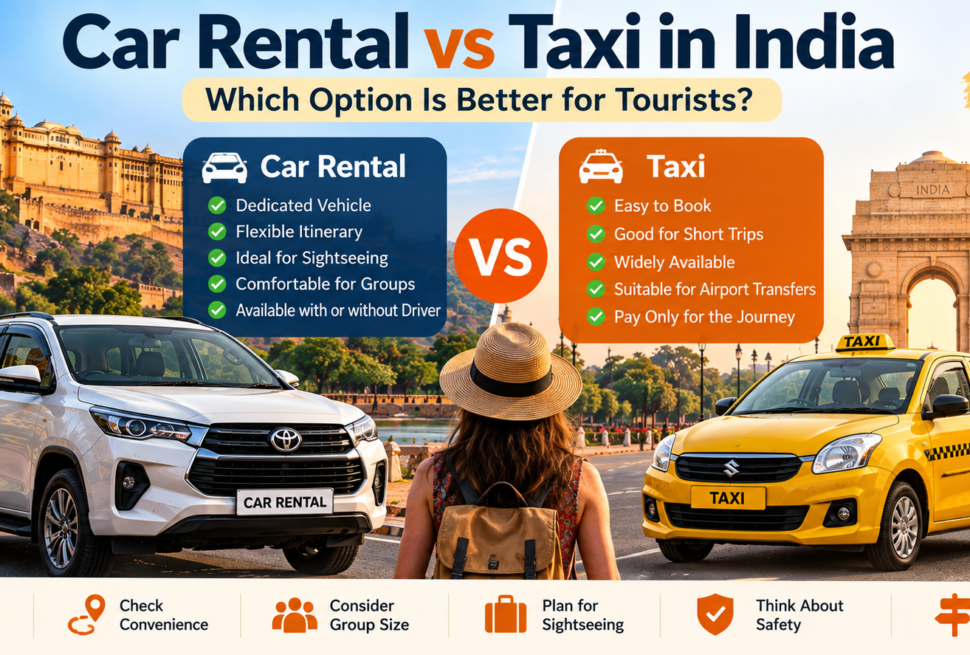
Self-Drive vs Chauffeur-Driven Car Rental
Both options have advantages.
| Feature | Self-Drive | Chauffeur-Driven |
|---|---|---|
| Driver required | No | Yes |
| Privacy | High | High |
| Flexibility | High | High |
| Navigation responsibility | Traveller | Driver |
| Traffic responsibility | Traveller | Driver |
| Licence requirements | Applicable | Generally not for passenger |
| Long-distance comfort | Depends on driver | Generally convenient |
| Best for | Experienced drivers | Tourists and multi-city trips |
Self-drive gives you control over the vehicle and schedule.
A chauffeur-driven vehicle lets you focus more on sightseeing and reduces the need to navigate unfamiliar roads.
The right choice depends on your itinerary, driving experience and personal preference.
Tips for Renting a Car in India
Book Early During Peak Travel Periods
Prices and availability can change during popular holidays and peak tourism periods.
Booking ahead gives you more choice in terms of vehicle category.
Ask for the Exact Car Model
Some rental companies advertise a vehicle category rather than a specific model.
If the exact model matters to you, ask whether it is guaranteed or provided on an equivalent basis.
Confirm the Number of Passengers
Do not assume that a five-seater is comfortable for five adults plus luggage.
For long journeys, extra space can make a significant difference.
Check the Vehicle Before Departure
For self-drive rentals, inspect the vehicle carefully.
Look for:
- Scratches
- Dents
- Broken lights
- Tyre damage
- Interior damage
- Fuel level
- Existing marks
Take photographs before starting your journey.
Keep Emergency Numbers
Save the rental company’s customer service number.
If you have a chauffeur, save the driver’s phone number as well.
India’s national emergency number is 112, although travellers should also retain the relevant local and service-provider contacts for their journey.
Avoid Unrealistic Itineraries
One common mistake is trying to cover too many destinations in a short period.
Road travel can take longer than expected because of traffic, weather, road conditions, construction and sightseeing stops.
Give yourself enough time between destinations.
Car Rental for Popular Indian Tourist Routes
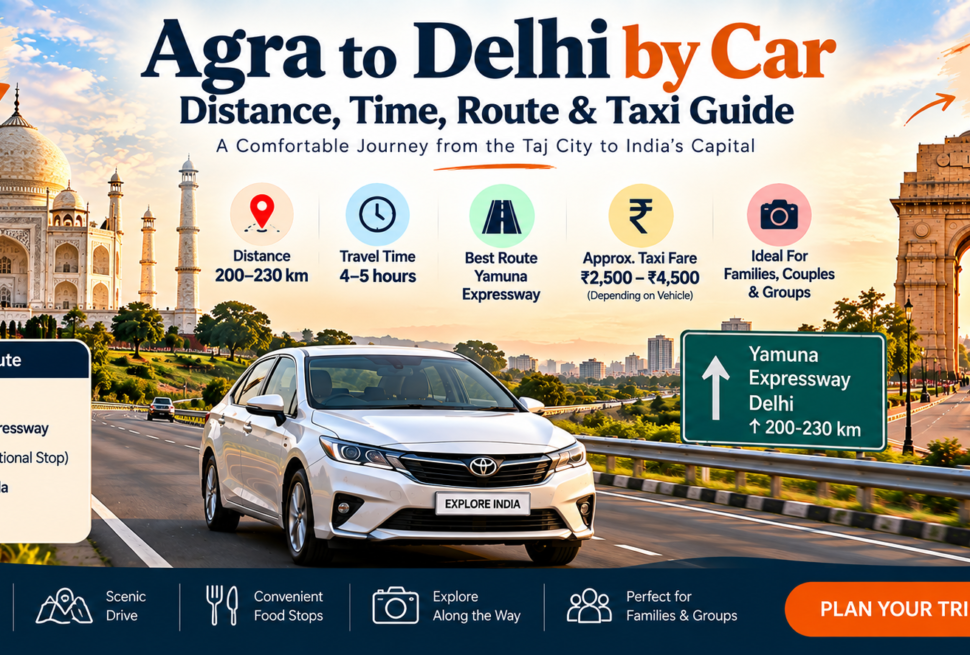
Delhi to Agra
A private car can be convenient for travellers visiting the Taj Mahal and Agra Fort.
It can also provide flexibility for travellers who want to combine multiple attractions in one day.
Delhi to Jaipur
A private car is useful for travellers who want to travel between Delhi and Jaipur without following a fixed train schedule.
Delhi – Agra – Jaipur
This is the classic Golden Triangle route.
A private vehicle can remain with you throughout the itinerary, allowing flexibility for sightseeing and hotel transfers.
Rajasthan Road Trips
Rajasthan is one of India’s most popular regions for private road travel.
Popular destinations include:
- Jaipur
- Pushkar
- Jodhpur
- Udaipur
- Jaisalmer
- Bikaner
For longer Rajasthan itineraries, discuss the total route and overnight stops with the rental provider before confirming the vehicle.
Kerala Road Trips
Kerala offers a completely different travel environment, with destinations such as Kochi, Munnar, Thekkady, Alleppey and Kovalam.
A private car can be convenient for travellers who want to explore multiple destinations without repeatedly arranging local transportation.
Hidden Costs to Watch Out For
When learning how to rent a car in India, understanding additional costs is just as important as knowing the base price.
Fuel
Self-drive rentals commonly charge fuel separately.
Toll Charges
Highway journeys can involve multiple toll payments.
Parking
Parking fees may apply at airports, hotels, attractions and commercial areas.
Interstate Taxes
Crossing state borders may involve additional taxes or permits depending on the vehicle and route.
Extra Kilometres
If your package includes a kilometre limit, additional kilometres may cost extra.
Driver Allowance
For multi-day chauffeur-driven trips, driver accommodation or daily allowance may be charged separately depending on the package.
Night Charges
Late-night pickups, extended hours or overnight travel may involve additional charges.
Always request a complete price breakdown before paying.
How to Avoid Car Rental Problems
A little preparation can prevent many common problems.
Get the Price in Writing
Ask for a written quotation containing all major charges.
Confirm the Pickup Location
Be precise about your hotel, airport terminal or other pickup point.
Check Cancellation Rules
Understand what happens if your flight is delayed or your travel plans change.
Verify Insurance
For self-drive vehicles, understand what insurance is included and what your financial responsibility may be in case of damage.
Don’t Ignore the Rental Agreement
Read the agreement before accepting the vehicle.
Keep Receipts
Keep payment receipts and booking confirmations until your rental is completed and any security deposit has been returned.
Frequently Asked Questions
Is it easy to rent a car in India?
Yes. Car rental services are available in many major Indian cities and tourist destinations. The booking process generally involves selecting the vehicle, dates, rental type and itinerary, followed by payment and confirmation.
How much does it cost to rent a car in India?
Prices vary significantly. As a general 2026 planning range, self-drive cars can start around ₹1,100 per day for basic vehicles, while larger vehicles can cost several thousand rupees per day. Chauffeur-driven vehicles commonly cost more, depending on the vehicle and route.
Is fuel included in car rental prices?
Not always. Fuel policies vary by provider. Always ask whether fuel is included before confirming your booking.
Is a driver included with a rental car?
Only with chauffeur-driven rentals. Self-drive rentals do not normally include a driver.
Can tourists rent a car in India?
Yes, tourists can arrange car rental services in India. For self-drive, foreign visitors should verify their licence and documentation requirements before booking.
Should I rent a sedan or SUV?
A sedan can work well for couples and small groups. An SUV or MPV may be more comfortable for families, groups or travellers carrying several bags.
Can I rent a car for a week?
Yes. Weekly and multi-day rentals are available, and some providers offer lower effective daily rates for longer bookings.
Can I rent a car from Delhi and travel to Agra and Jaipur?
Yes. Delhi–Agra–Jaipur is one of the most common private-car tourism routes in North India.
Is chauffeur-driven car rental expensive?
The answer depends on the vehicle, route and inclusions. A chauffeur-driven service can sometimes be cost-effective for groups because one vehicle and driver can cover the entire itinerary. Current 2026 quotations vary considerably by provider and route.
Final Thoughts
Knowing how to rent a car in India can make planning your trip much easier.
The most important step is choosing the rental type that matches your itinerary. Self-drive vehicles provide independence, while chauffeur-driven cars can make sightseeing and long-distance travel more convenient, particularly for visitors unfamiliar with Indian roads.
Before making a booking, compare the complete price rather than just the advertised daily rate. Check fuel, tolls, parking, taxes, mileage limits, driver charges, insurance, security deposits and cancellation conditions.
Choose a vehicle that comfortably accommodates your passengers and luggage, and allow enough time for road journeys between destinations.
Whether you are planning a Delhi–Agra trip, a Golden Triangle holiday, a Rajasthan road trip or a longer journey across India, a well-planned car rental can give you the flexibility to explore more comfortably and make the most of your time.
The key is simple: understand the rental terms, choose the right vehicle, confirm the total cost and plan your route realistically.
With these steps in mind, renting a car in India can become a straightforward part of your travel planning.