Introduction
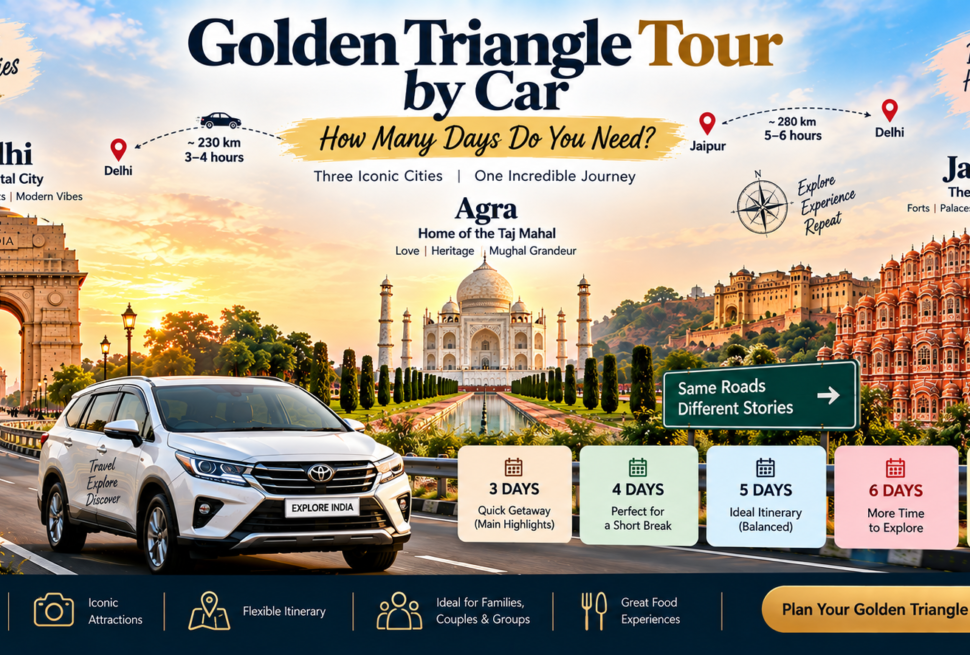
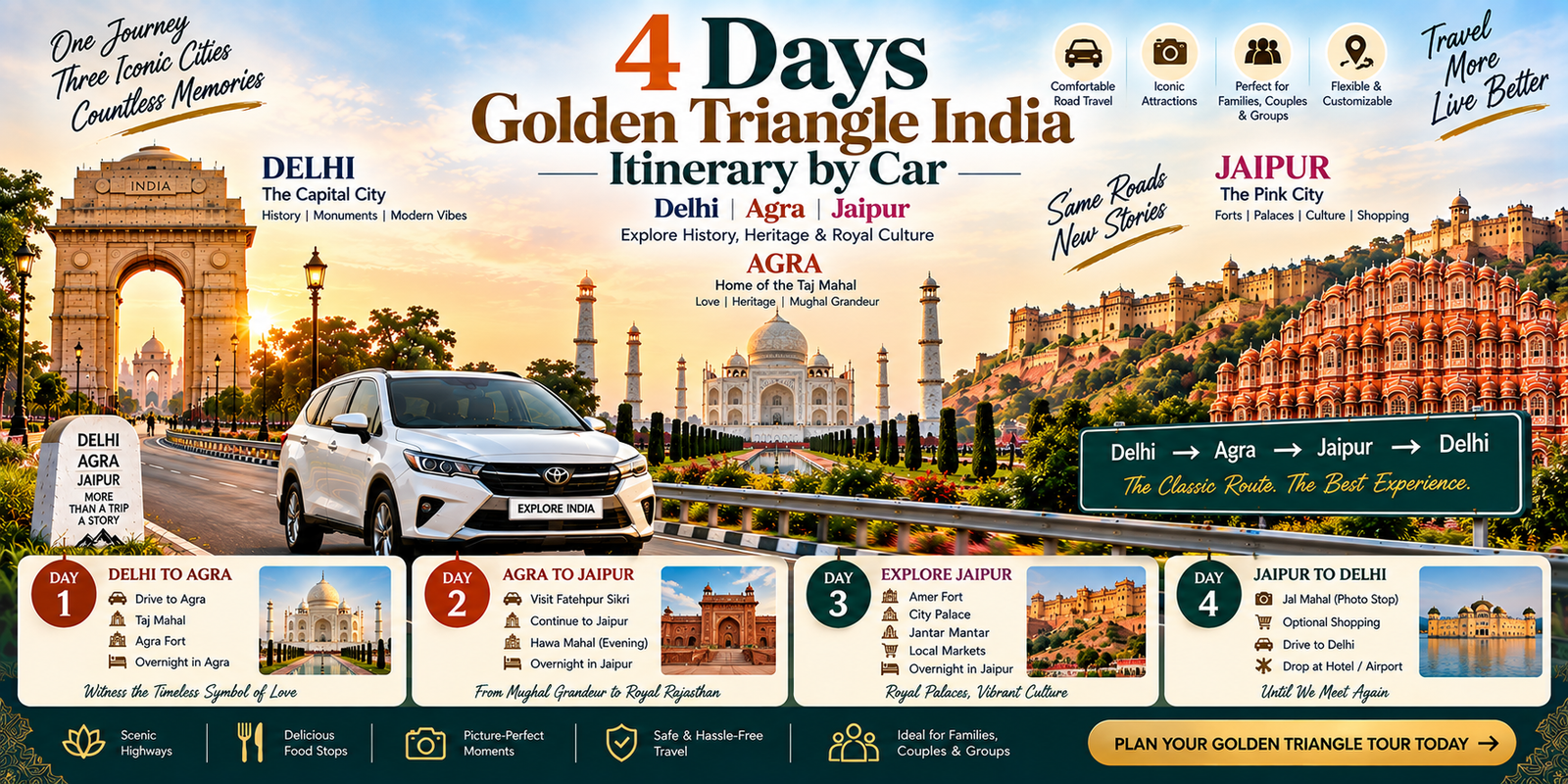
A 4 Days Golden Triangle India Itinerary by Car is a convenient way to experience three of North India’s most famous destinations — Delhi, Agra and Jaipur — in one well-planned journey.
Known as India’s Golden Triangle, this classic route connects the country’s capital, the city of the Taj Mahal and Rajasthan’s famous Pink City. Travelling by private car gives you more flexibility than following a fixed train schedule. You can choose your departure times, stop for meals and photographs, visit attractions along the route and adjust the sightseeing schedule according to your interests.
In four days, you can explore the highlights of Delhi, admire the Taj Mahal and Agra Fort, visit Fatehpur Sikri and discover Jaipur’s forts, palaces and historic markets.
For a first-time visitor to India, this itinerary provides a practical combination of history, architecture, culture, food and road travel.
4 Days Golden Triangle Itinerary at a Glance
| Day | Route | Main Highlights | Overnight |
|---|---|---|---|
| Day 1 | Delhi → Agra | Delhi sightseeing, Taj Mahal, Agra Fort | Agra |
| Day 2 | Agra → Jaipur | Fatehpur Sikri, Jaipur sightseeing | Jaipur |
| Day 3 | Jaipur | Amber Fort, City Palace, Jantar Mantar, Hawa Mahal | Jaipur |
| Day 4 | Jaipur → Delhi | Jal Mahal, shopping, return to Delhi | Delhi / Departure |
This itinerary can also be modified depending on your arrival and departure flights.
Why Choose a 4-Day Golden Triangle Tour by Car?
Four days gives you more breathing room than an extremely short 3-day Golden Triangle trip.
With a private car, you can:
- Travel directly between destinations
- Stop at attractions on the way
- Carry luggage comfortably
- Choose your departure time
- Avoid changing trains with luggage
- Make restaurant and photography stops
- Travel comfortably with family or children
- Add optional attractions
- Customize the itinerary according to your interests
The route is especially convenient for families, couples, small groups and international visitors who want a private travel experience.
Rajasthan Tourism itself includes Delhi–Agra, Agra–Jaipur and Jaipur–Delhi journeys within its suggested itineraries, demonstrating how naturally these destinations fit into a broader North India circuit.
Day 1: Delhi to Agra – Taj Mahal & Agra Fort
Route: Delhi → Agra
Approximate driving distance: 200–230+ km depending on the route and starting point
Suggested departure: 5:00–6:00 AM
Overnight: Agra
Your first day begins in Delhi.
If you have already explored Delhi before the tour, you can leave early and travel directly to Agra. If this is your first visit and your schedule permits, you can include one or two Delhi attractions before departing.
Suggested Delhi Morning Stops
Depending on your departure location and available time, you could visit:
- India Gate
- President’s area
- Qutub Minar
- Humayun’s Tomb
- Lotus Temple
- Raj Ghat
Do not try to visit every attraction before leaving Delhi. The objective of this itinerary is to reach Agra early enough to enjoy its major monuments.
Drive from Delhi to Agra
After Delhi sightseeing, continue toward Agra.
The Yamuna Expressway is one of the commonly used routes between Delhi and Agra. The exact journey time depends on traffic, starting location, road conditions and breaks.
A private car allows you to stop when required rather than following a fixed departure schedule.
Visit the Taj Mahal
The Taj Mahal should be the centerpiece of your Agra experience.
Ideally, plan your visit around the morning or another suitable time based on your arrival and the day’s schedule.
The official Taj Mahal website states that the monument normally opens 30 minutes before sunrise and closes 30 minutes after sunset. It is closed to general visitors every Friday.
This makes it important to check the calendar before finalizing your itinerary.
The official website currently lists the regular Taj Mahal admission at ₹50 for Indian/OCI visitors and ₹1,100 for foreign visitors, with an additional ₹200 ticket for visitors who choose to enter the main mausoleum. Children below 15 are listed as exempt from the entry fee.
What to See at the Taj Mahal
Allow approximately 2–3 hours for a comfortable visit.
You can explore:
- Main Taj Mahal complex
- Charbagh gardens
- Main mausoleum
- Mosque
- Guest house
- Marble inlay details
- Yamuna River views
- Main entrance architecture
The Taj is also one of the most important photography locations on the Golden Triangle route.
Lunch in Agra
After visiting the Taj Mahal, enjoy lunch at a restaurant or hotel.
You can try popular North Indian dishes such as:
- Mughlai cuisine
- Tandoori dishes
- Butter chicken
- Dal
- Naan
- Biryani
- Vegetarian thali
If travelling during summer, take a short break before continuing sightseeing.
Visit Agra Fort
After lunch, visit Agra Fort, another major Mughal-era landmark.
The fort contains massive walls, courtyards, palaces and historic structures connected with the Mughal period.
Spend approximately 1.5–2 hours here.
The official Taj Mahal tourism website currently lists Agra Fort admission at ₹50 for Indian visitors and ₹650 for foreign visitors on regular days, with different rates applicable on Fridays.
Optional Evening Attractions in Agra
If you still have time and energy, choose one additional attraction.
Mehtab Bagh
Located across the Yamuna, Mehtab Bagh provides a different perspective toward the Taj Mahal.
Itimad-ud-Daulah
Often called the “Baby Taj,” this monument is known for its detailed marble work and decorative inlay.
Agra Local Market
You can also spend some time exploring Agra’s handicrafts and marble inlay products.
Overnight in Agra
Check into your hotel and relax.
Suggested evening
7:30 PM: Dinner
8:30 PM: Relax at hotel
10:00 PM: Sleep early
A good night’s sleep is useful because Day 2 includes a road journey to Jaipur.
Day 2: Agra to Jaipur via Fatehpur Sikri
Route: Agra → Fatehpur Sikri → Jaipur
Approximate driving distance: Around 250 km depending on route
Travel time: Around 5 hours of driving, excluding sightseeing and breaks
Overnight: Jaipur
Start Day 2 after breakfast.
One of the major advantages of travelling by private car is that you can turn the journey between Agra and Jaipur into a sightseeing day.
Rajasthan Tourism lists the Jaipur–Agra journey at approximately 250 km / 5 hours and specifically includes Fatehpur Sikri as an en-route attraction.
Stop at Fatehpur Sikri
Fatehpur Sikri is an impressive historic city located on the route between Agra and Jaipur.
The complex is associated with Emperor Akbar and contains impressive Mughal-era architecture.
Highlights include:
- Buland Darwaza
- Jama Masjid
- Panch Mahal
- Diwan-i-Khas
- Jodha Bai’s Palace
- Palace courtyards
- Historic gateways
Allow approximately 1.5–2 hours for sightseeing.
The official Taj Mahal ticketing information currently lists Fatehpur Sikri admission at ₹50 for Indian visitors and ₹610 for foreign visitors on regular days.
Continue to Jaipur
After Fatehpur Sikri, continue toward Jaipur.
Depending on your departure time and stops, you can expect to reach Jaipur in the afternoon or early evening.
Check into your hotel and take some time to relax.
Jaipur Evening Sightseeing
If you reach Jaipur early enough, begin with a short city sightseeing session.
Hawa Mahal
The iconic Palace of Winds is one of Jaipur’s most recognizable landmarks.
The pink façade makes it particularly attractive for photography.
City Palace Area
Explore the historic center around City Palace and Jaipur’s traditional markets.
Jantar Mantar
If opening hours fit your schedule, you can visit Jantar Mantar, the famous astronomical observatory.
Explore Jaipur’s Markets
Jaipur is well known for handicrafts and traditional products.
Popular shopping areas include:
- Johari Bazaar
- Bapu Bazaar
- Tripolia Bazaar
- Nehru Bazaar
You can look for:
- Block-printed textiles
- Blue pottery
- Jewelry
- Handicrafts
- Leather products
- Traditional clothing
- Souvenirs
Return to your hotel after dinner.
Day 3: Full-Day Jaipur Sightseeing
Route: Jaipur local sightseeing
Overnight: Jaipur
Day 3 is your main Jaipur sightseeing day.
Start after breakfast.
Visit Amber Fort
Begin with Amber Fort, located outside central Jaipur.
The fort is famous for:
- Grand gateways
- Courtyards
- Palace architecture
- Decorative halls
- Hilltop views
- Mughal-Rajput architectural elements
Spend approximately 2–3 hours exploring the complex.
Morning is generally a comfortable time to visit because outdoor areas can become hot later in the day.
Jal Mahal
After Amber Fort, stop at Jal Mahal.
The palace appears to rise from the middle of Man Sagar Lake and is one of Jaipur’s most photographed landmarks.
Usually, visitors enjoy the view from the roadside rather than spending a long period here.
Allow around 20–30 minutes for a photo stop.
City Palace
Continue toward the City Palace area.
The complex combines courtyards, gateways, museums and royal architecture.
Depending on your interests, spend approximately 1.5–2 hours here.
Jantar Mantar
Jantar Mantar is located close to City Palace.
The astronomical observatory contains large-scale instruments designed for astronomical observations.
Allow approximately 45–60 minutes.
Hawa Mahal
After visiting the City Palace and Jantar Mantar area, stop at Hawa Mahal.
The best experience can include viewing the façade from the street and exploring the surrounding historic neighborhood.
Jaipur Lunch
Take a lunch break in the old city.
You can try:
- Rajasthani thali
- Dal Baati Churma
- Gatte ki Sabzi
- Ker Sangri
- Bajra roti
- Lassi
A traditional Rajasthani meal can become one of the memorable parts of your Golden Triangle journey.
Optional Jaipur Attractions
If you have additional time, choose one of these:
Nahargarh Fort
Good for panoramic views over Jaipur.
Jaigarh Fort
Known for its historic fortifications and military architecture.
Albert Hall Museum
A useful option for visitors interested in art, history and museums.
Birla Mandir
A peaceful temple option for the evening.
Jaipur Evening Experience
Keep the final evening relatively relaxed.
You can:
- Explore local markets
- Enjoy a traditional dinner
- Visit a cultural performance
- Photograph Jaipur after sunset
- Relax at your hotel
Avoid overloading the evening with too many attractions because Day 4 includes the drive back to Delhi.
Day 4: Jaipur to Delhi
Route: Jaipur → Delhi
Approximate driving distance: Around 270–300 km depending on the route and starting point
Travel time: Approximately 5–6 hours, depending on traffic and stops
End: Delhi
Wake up and have breakfast at your hotel.
Before leaving Jaipur, you can make a final short sightseeing or shopping stop.
Optional Morning Stops
Jal Mahal
If you missed it on Day 3, make a quick morning photo stop.
Local Market
Purchase souvenirs and handicrafts.
Hawa Mahal
Take final photographs before beginning your journey.
Drive Jaipur to Delhi
Start your return journey toward Delhi.
The road journey normally takes several hours, so leaving Jaipur earlier gives you more flexibility.
Your driver can arrange a meal or tea break during the journey.
Once you arrive in Delhi, you can be dropped at:
- Delhi Airport
- New Delhi Railway Station
- Hotel
- Residential address
- Another agreed location
This makes the itinerary convenient for travelers flying out of Delhi after completing the Golden Triangle.
4 Days Golden Triangle Route
The complete route looks like this:
Delhi → Agra → Fatehpur Sikri → Jaipur → Delhi
This creates a practical loop without requiring you to return to the same city between every destination.
Approximate route structure
Day 1: Delhi → Agra
Day 2: Agra → Fatehpur Sikri → Jaipur
Day 3: Jaipur sightseeing
Day 4: Jaipur → Delhi
Best Car for a 4-Day Golden Triangle Tour
Your choice of vehicle depends mainly on group size and luggage.
Sedan
Best for:
- Couples
- Solo travelers
- Small families
- 2–3 passengers with moderate luggage
A sedan is generally sufficient for a standard Golden Triangle itinerary.
SUV
An SUV can be more comfortable for:
- Families
- 4–6 travelers
- Travelers with larger luggage
- People who prefer additional cabin space
It can also be useful if you want additional comfort during longer road journeys.
Tempo Traveller
For larger groups, a Tempo Traveller may be more practical.
It can suit:
- Family groups
- Friends
- Corporate groups
- Extended families
- Small tour groups
The exact seating configuration varies by vehicle and operator.
Chauffeur-Driven vs Self-Drive
For a 4-day Golden Triangle itinerary, many visitors prefer a chauffeur-driven vehicle because it allows them to focus on sightseeing instead of navigating unfamiliar roads.
Chauffeur-Driven Car
Advantages include:
- Local route knowledge
- No need to drive
- Flexible sightseeing
- Easier parking arrangements
- Comfortable long-distance travel
- Convenient hotel-to-monument transfers
Self-Drive
Self-drive can provide greater independence, but travelers should be comfortable with Indian traffic conditions, navigation, local driving practices and parking.
For international visitors in particular, documentation and driving requirements should be checked before choosing a self-drive rental.
Estimated Cost of a 4-Day Golden Triangle Tour by Car
The final price depends on:
- Vehicle type
- Number of passengers
- Travel season
- Hotel category
- Chauffeur charges
- Fuel
- Toll charges
- Parking
- Monument tickets
- Guide services
- Meals
- Additional sightseeing
- Pickup and drop-off locations
General planning structure
| Expense | Budget | Mid-Range | Premium |
|---|---|---|---|
| Car & Driver | Lower | Moderate | Higher |
| Hotels | Budget hotels | 3–4 star | 4–5 star |
| Meals | Local restaurants | Good restaurants | Premium dining |
| Guides | Optional | Selected monuments | Private guides |
| Activities | Basic | Moderate | More experiences |
Because operator pricing changes, it is better to request a current quotation rather than relying on one fixed online price.
Where to Stay
Delhi
For a pre-tour or post-tour night, consider areas such as:
- Connaught Place
- Aerocity
- South Delhi
- Karol Bagh
Agra
Convenient areas include:
- Taj Ganj
- Fatehabad Road
- Taj East Gate area
Staying relatively close to the Taj Mahal can make an early morning visit easier.
Jaipur
Popular areas include:
- C-Scheme
- MI Road
- Bani Park
- Civil Lines
- Old Jaipur
Your choice should depend on whether you prioritize sightseeing, shopping, restaurants or hotel amenities.
Best Time for a 4-Day Golden Triangle Tour
The Golden Triangle can be visited throughout the year, but weather can influence the experience.
October to March
This is generally a comfortable period for sightseeing because temperatures are more pleasant.
It is also a popular travel season.
April to June
Temperatures can become very high, particularly during afternoon sightseeing.
Start outdoor activities early and carry water, sunscreen and appropriate clothing.
July to September
The monsoon season can bring rain and humidity.
However, some travelers prefer this period because of greener landscapes and potentially lower travel demand.
Important Taj Mahal Planning Tip
When building your itinerary, always check which day of the week you will visit Agra.
The Taj Mahal is closed every Friday for general viewing. The official Taj Mahal website confirms that regular visiting hours run from 30 minutes before sunrise to 30 minutes after sunset on open days.
Therefore, if your four-day itinerary places Agra on Friday, rearrange the route.
For example:
Delhi → Jaipur → Agra → Delhi
can sometimes be considered instead, depending on your dates and available time.
What to Pack
For a four-day Golden Triangle road trip, pack light but practical.
Clothing
- Comfortable walking shoes
- Lightweight clothes
- A light jacket during cooler months
- Sunglasses
- Hat or cap
Travel essentials
- Government-issued ID
- Passport for international travelers
- Phone charger
- Power bank
- Sunscreen
- Reusable water bottle
- Basic medicines
- Camera
For monument visits
Wear comfortable footwear because several attractions involve considerable walking.
Tips for a Smooth Golden Triangle Road Trip
1. Start Early
Early departures help you maximize sightseeing time.
2. Keep Some Flexibility
Road traffic can affect arrival times, so avoid scheduling every activity down to the minute.
3. Book Hotels in Advance
This is particularly useful during peak travel periods.
4. Check Monument Closures
Always verify opening days before finalizing your route.
5. Keep Your Passport and ID Secure
International travelers should carry the required identification documents.
6. Use Licensed Guides
A knowledgeable guide can provide historical context and help you understand the architecture.
7. Avoid Overpacking the Itinerary
Three cities in four days already involve considerable travel.
Choose the attractions that matter most to you rather than trying to see everything.
Is 4 Days Enough for the Golden Triangle?
Yes, four days can work well for a highlights-focused Golden Triangle trip.
You can experience:
Delhi
- India Gate
- Qutub Minar
- Humayun’s Tomb
- Old Delhi
Agra
- Taj Mahal
- Agra Fort
- Mehtab Bagh
- Itimad-ud-Daulah
Fatehpur Sikri
- Buland Darwaza
- Jama Masjid
- Palace complex
Jaipur
- Amber Fort
- City Palace
- Jantar Mantar
- Hawa Mahal
- Jal Mahal
- Local markets
However, if you want a slower experience with longer cultural activities, shopping and additional attractions, extending the trip to five or six days can provide more time.
4 Days vs 5 Days Golden Triangle Tour
| Feature | 4 Days | 5 Days |
|---|---|---|
| Delhi | Highlights | More relaxed |
| Agra | 1 day | 1–1.5 days |
| Fatehpur Sikri | Yes | Yes |
| Jaipur | 1.5–2 days | 2 full days |
| Shopping | Limited | More time |
| Pace | Fast | More relaxed |
| Best for | First-time highlights | Deeper experience |
If your priority is seeing the major landmarks efficiently, four days is practical.
If you prefer slow travel, five days is more comfortable.
Frequently Asked Questions
How many days are enough for the Golden Triangle in India?
Four days are enough for a highlights-focused Delhi, Agra and Jaipur itinerary. Five to seven days allow more relaxed sightseeing.
What is the best way to travel the Golden Triangle?
A private car provides flexibility for travelers who want to combine Delhi, Agra and Jaipur with stops such as Fatehpur Sikri.
Can I do the Golden Triangle in 4 days by car?
Yes. A practical route is Delhi → Agra → Fatehpur Sikri → Jaipur → Delhi.
How far is Delhi from Agra?
The exact road distance depends on your starting point and route. Rajasthan Tourism’s suggested itinerary uses approximately 225 km for the Delhi–Agra journey.
How far is Agra from Jaipur?
Rajasthan Tourism lists the Jaipur–Agra journey at approximately 250 km and around five hours of driving, before sightseeing stops.
Can I visit Fatehpur Sikri between Agra and Jaipur?
Yes. Fatehpur Sikri is a natural stop on the Agra–Jaipur route and can be included as part of Day 2.
Is a private car better for families?
A private car can be convenient for families because it provides door-to-door travel, luggage space and flexibility with breaks.
Can I customize the 4-day itinerary?
Yes. You can add or remove attractions according to your interests, arrival time, departure time and travel pace.
Can international tourists take this Golden Triangle tour?
Yes. International travelers commonly visit Delhi, Agra and Jaipur as part of India’s classic tourism circuit. Carry your passport and required travel documents and check current monument entry requirements.
What happens if the Taj Mahal is closed on my planned day?
Because the Taj Mahal is closed every Friday, adjust your itinerary so that Agra falls on another day. The official Taj Mahal website should be checked before your trip.
Final 4-Day Golden Triangle Itinerary
Day 1 — Delhi → Agra
Morning: Depart Delhi
Late morning: Taj Mahal
Afternoon: Lunch + Agra Fort
Evening: Mehtab Bagh or local market
Night: Stay in Agra
Day 2 — Agra → Fatehpur Sikri → Jaipur
Morning: Breakfast and departure
Late morning: Fatehpur Sikri
Afternoon: Continue to Jaipur
Evening: Hawa Mahal / local market
Night: Stay in Jaipur
Day 3 — Jaipur
Morning: Amber Fort
Late morning: Jal Mahal
Afternoon: City Palace + Jantar Mantar
Evening: Hawa Mahal / shopping / cultural experience
Night: Stay in Jaipur
Day 4 — Jaipur → Delhi
Morning: Breakfast + optional sightseeing
Late morning: Depart Jaipur
Afternoon: Road journey toward Delhi
Evening: Arrive in Delhi
Departure: Airport, railway station or hotel
Conclusion
A 4 Days Golden Triangle India Itinerary by Car offers a compact introduction to India’s most famous northern heritage circuit.
From the modern and historic character of Delhi to the architectural magnificence of the Taj Mahal and Agra Fort, followed by Jaipur’s forts, palaces and colorful markets, the journey brings together several different sides of India within a single road trip.
The ideal route is:
Delhi → Agra → Fatehpur Sikri → Jaipur → Delhi
A private car makes the journey particularly flexible, allowing you to control departure times, sightseeing stops, meals and optional attractions.
For first-time visitors looking for a combination of history, culture, architecture, food and comfortable road travel, four days provides a practical Golden Triangle introduction.