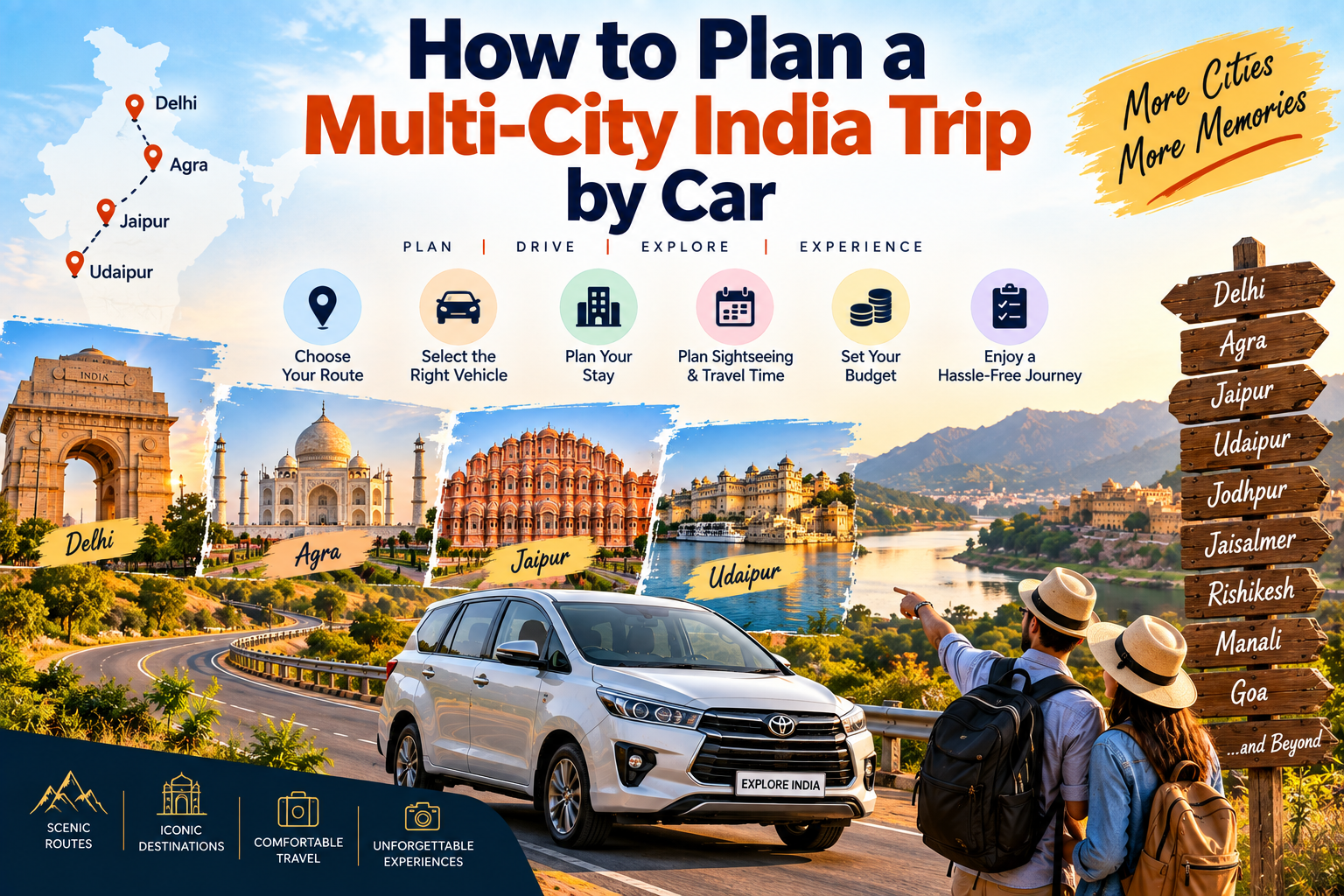
Planning a multi-city India trip by car is one of the best ways to experience the country’s incredible variety. Instead of travelling only between major airports or railway stations, a private car gives you the flexibility to connect historic cities, cultural destinations, wildlife areas, hill stations, spiritual centres and scenic landscapes at your own pace.
A well-planned road trip can take you from Delhi to Agra, Jaipur, Jodhpur and Udaipur, or from Delhi to Rishikesh, Haridwar and the Himalayan foothills. You can also design longer routes through Rajasthan, Kerala, South India or the Golden Triangle.
However, planning a multi-city road trip is different from booking a simple taxi. You need to think about distances, driving hours, accommodation, vehicle type, luggage, sightseeing time, fuel, tolls, driver arrangements and rest days.
This complete guide explains how to plan a multi-city India trip by car, including how to choose your route, calculate driving time, select the right vehicle, estimate costs and avoid common road-trip mistakes.
SEO Information
SEO Title:
How to Plan a Multi-City India Trip by Car: Complete Guide
Meta Description:
Learn how to plan a multi-city India trip by car with route ideas, car rental tips, driving times, costs, hotels, sightseeing and practical road trip advice.
Slug:how-to-plan-a-multi-city-india-trip-by-car
Focus Keyphrase:
How to Plan a Multi-City India Trip by Car
Secondary Keywords:
- multi-city India trip by car
- India road trip itinerary
- India road trip by car
- private car tour India
- car rental for India road trip
- chauffeur-driven car India
- India multi-city tour
- best India road trip routes
- India car rental itinerary
- road trip across India
- India travel by private car
- multi-city car rental India
Why Plan a Multi-City India Trip by Car?
India is a large country with thousands of attractions spread across different regions.
Travelling by private car gives you an opportunity to experience destinations between major cities rather than simply moving from one transport hub to another.
A multi-city road trip offers several advantages.
Flexibility
You can decide when to leave, where to stop and how long to spend at different attractions.
Door-to-Door Travel
Your car can pick you up from your hotel and take you directly to your next accommodation.
Easier Sightseeing
You can visit attractions located outside city centres without arranging separate transportation.
Comfortable Group Travel
Families and small groups can travel together with their luggage.
Scenic Journeys
Some of India’s most memorable experiences happen between destinations rather than inside them.
For example, a Rajasthan road trip can include forts, villages, desert landscapes and historic towns along the way.
Step 1: Decide How Many Cities You Want to Visit
The first mistake many travellers make is trying to visit too many destinations.
India is large, and distances that appear short on a map can take considerably longer because of traffic, road conditions, sightseeing stops and city congestion.
For a one-week trip, visiting three or four major destinations may be more comfortable than trying to cover eight cities.
For a two-week trip, you can consider a longer itinerary with several overnight stops.
A simple approach is:
7 days: 3–4 destinations
10 days: 4–5 destinations
14 days: 5–7 destinations
3 weeks or more: Longer regional circuits
These are planning guidelines rather than fixed rules. Your travel style and the distance between destinations matter more than the number of cities.
Step 2: Choose One Geographic Region
If you want an enjoyable road trip, avoid creating an itinerary that constantly crosses the entire country.
Instead, choose destinations that naturally connect by road.
Northern India
Example:
Delhi → Agra → Jaipur → Jodhpur → Udaipur
Rajasthan
Example:
Jaipur → Pushkar → Jodhpur → Jaisalmer → Udaipur
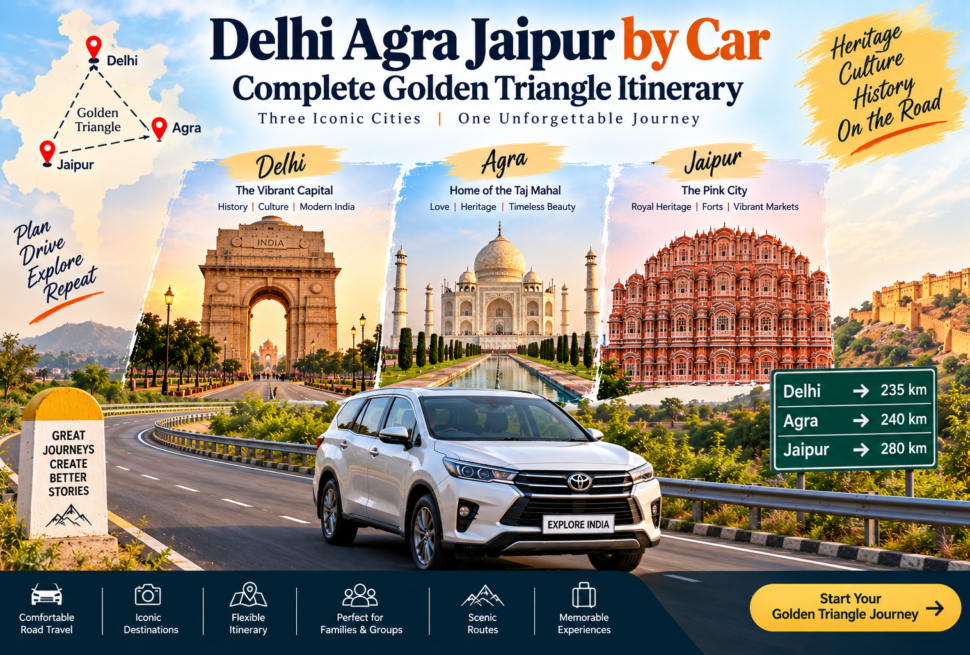
Golden Triangle
Example:
Delhi → Agra → Jaipur → Delhi
Uttarakhand
Example:
Delhi → Haridwar → Rishikesh → Mussoorie → Nainital
Kerala
Example:
Kochi → Munnar → Thekkady → Alleppey → Kovalam
South India
Example:
Bengaluru → Mysuru → Ooty → Coimbatore → Kochi
Regional planning reduces unnecessary driving and gives you more time for sightseeing.
Step 3: Build Your Route Around Travel Time
Don’t plan your itinerary only according to the number of cities.
Think about driving hours.
For example, if you arrive in Jaipur at 10 AM and plan to leave for Jodhpur immediately after lunch, you may not have enough time to properly experience Jaipur.
Instead, consider staying at least one or two nights in major destinations.
A comfortable itinerary often follows this pattern:
Arrival → Sightseeing → Overnight stay → Morning sightseeing → Road journey → New destination
This gives you enough time to enjoy both the destination and the journey.
Step 4: Don’t Drive Every Day
A multi-city trip should not become a continuous driving marathon.
If you spend six or seven hours in a car every day, you may arrive at your destination exhausted.
Build rest and sightseeing days into the itinerary.
For example:
Day 1
Arrive in Delhi
Day 2
Delhi sightseeing
Day 3
Delhi → Agra
Day 4
Agra → Jaipur
Day 5
Jaipur sightseeing
Day 6
Jaipur → Jodhpur
Day 7
Jodhpur sightseeing
This structure gives you a mixture of driving and exploration.
Step 5: Choose Between Self-Drive and Chauffeur-Driven Travel
This is one of the most important decisions when planning a multi-city India road trip.
Self-Drive
Self-drive gives you complete control over your itinerary.
You can:
- Stop whenever you want
- Change your schedule
- Explore independently
- Take spontaneous detours
- Travel privately
However, you are responsible for:
- Driving
- Navigation
- Parking
- Traffic
- Fuel
- Road conditions
International visitors should also confirm the applicable driving-document requirements before choosing self-drive.
Chauffeur-Driven Car
A chauffeur-driven vehicle includes a professional driver.
This can be particularly useful for:
- International tourists
- First-time visitors
- Families
- Senior travellers
- Long-distance journeys
- Multi-city tours
The driver handles the road while you concentrate on sightseeing.
For many tourists, a chauffeur-driven car is a convenient option because Indian traffic and road conditions can vary considerably between cities and regions.
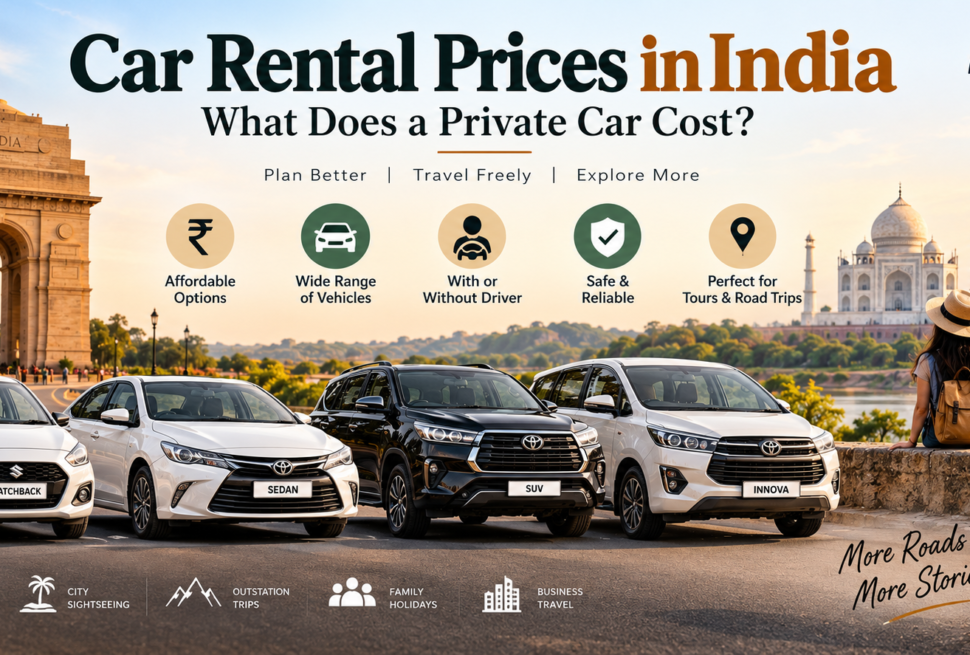
Step 6: Choose the Right Vehicle
Your vehicle should match your group size and itinerary.
Sedan
Suitable for:
- Couples
- Solo travellers
- Small families
- Short and medium road trips
A sedan can be economical and easy to manoeuvre.
SUV
Suitable for:
- Families
- Small groups
- Long road trips
- Travellers with more luggage
- Some hill routes
SUVs generally provide additional cabin and luggage space.
MPV
An MPV can be useful for families or groups requiring more seating capacity.
Tempo Traveller
For larger groups, a Tempo Traveller can allow everyone to travel together.
This can be particularly useful for:
- Family groups
- Pilgrimage tours
- Corporate trips
- Wedding groups
- Large friend groups
Step 7: Calculate Your Luggage Requirements
Don’t choose a car based only on passenger capacity.
Consider your luggage.
For example:
2 people + 2 medium bags: Sedan can be sufficient.
4 people + 4 large suitcases: SUV may be more comfortable.
6–7 people + luggage: Larger SUV or MPV.
10+ people: Tempo Traveller or similar group vehicle.
The vehicle should provide enough space for passengers to sit comfortably without having luggage stacked dangerously inside the passenger area.
Step 8: Create a Realistic Daily Driving Schedule
A common mistake is underestimating driving time.
When planning your route, consider:
- Traffic
- Road conditions
- City congestion
- Highway stops
- Meals
- Fuel stops
- Photography
- Bathroom breaks
- Attractions along the route
A journey that looks short on a map may take considerably longer in real-world conditions.
For a relaxed holiday, avoid scheduling long-distance travel immediately before an important sightseeing day.
Step 9: Plan Your Hotels Around the Route
Your hotel location can make a significant difference.
If you arrive in a city late at night and your hotel is far outside the main area, you may spend additional time travelling.
When choosing hotels, consider:
- Location
- Parking availability
- Road access
- Distance from attractions
- Distance from the next day’s departure route
- Hotel check-in time
For road trips, a hotel with convenient vehicle access and parking can sometimes be more practical than a property located deep inside a crowded historic area.
Step 10: Plan Your Sightseeing Before Leaving
You don’t need to schedule every minute, but identify the major attractions in advance.
For example, in Jaipur you might want to visit:
- Amber Fort
- City Palace
- Hawa Mahal
- Jantar Mantar
- Jal Mahal
In Agra:
- Taj Mahal
- Agra Fort
- Mehtab Bagh
- Itmad-ud-Daulah
In Delhi:
- India Gate
- Qutub Minar
- Humayun’s Tomb
- Red Fort
- Lotus Temple
Knowing your priorities allows your driver and hotel schedule to be organised more efficiently.
Step 11: Keep Some Flexibility
A road trip should not be so tightly scheduled that one delay ruins the entire itinerary.
Leave some flexibility for:
- Traffic
- Weather
- Unexpected sightseeing opportunities
- Restaurant stops
- Shopping
- Photography
- Fatigue
- Hotel delays
A good road trip itinerary has structure without being rigid.
Step 12: Understand Car Rental Pricing
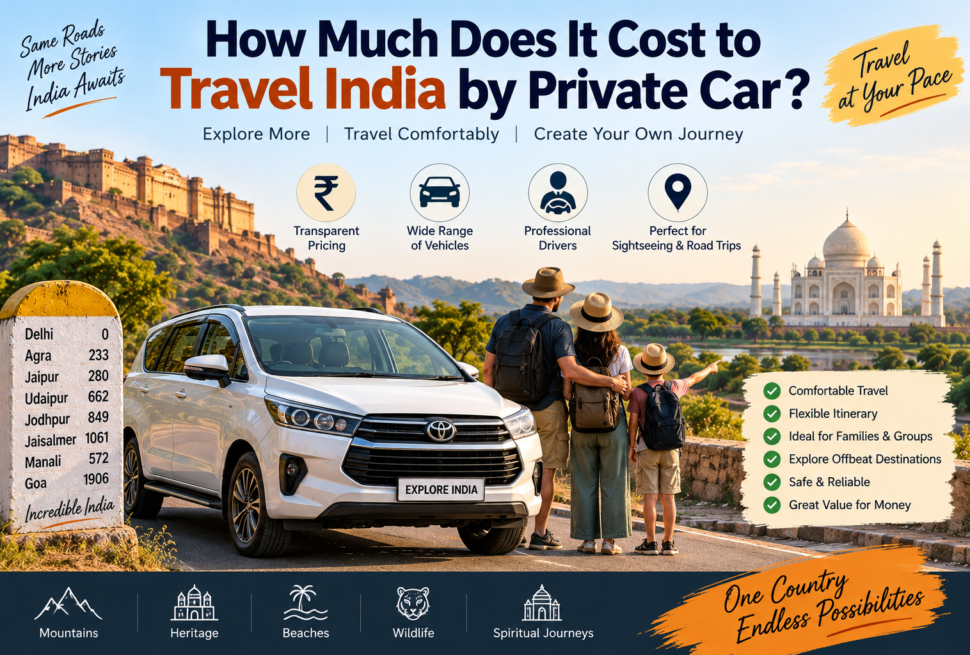
The cost of a multi-city car trip depends on several factors.
These can include:
- Vehicle type
- Number of days
- Total kilometres
- Fuel
- Driver allowance
- Toll charges
- Parking
- Interstate taxes
- Night charges
- One-way fees
- Additional hours
Always ask the rental company for a complete quotation.
Don’t compare operators only on the advertised daily rental price.
Example Multi-City Cost Structure
Suppose you are planning a seven-day chauffeur-driven trip.
Your transportation budget may include:
Vehicle rental
Fuel
Driver allowance
Tolls
Parking
Taxes
Additional kilometres
The exact amount depends on the route and rental package.
Some operators offer all-inclusive packages, while others separate individual expenses.
Ask for a written breakdown before confirming your booking.
Step 13: Understand Kilometer Limits
Some car rental packages include a fixed number of kilometres.
For example, a local package might provide a specified distance allowance.
If your trip covers hundreds or thousands of kilometres, make sure the package is designed for outstation travel.
Ask:
“How many kilometres are included in the complete itinerary?”
Then compare the included distance with your planned route.
Step 14: Check Fuel and Toll Policies
Fuel and toll charges can significantly affect the final cost.
Ask whether:
- Fuel is included
- Tolls are included
- Parking is included
- Driver allowance is included
- Interstate taxes are included
For self-drive rentals, fuel is generally paid separately.
For chauffeur-driven packages, fuel may be included depending on the agreement.
Never assume.
Step 15: Choose the Right Driver Arrangement
If you are booking a chauffeur-driven car for several days, ask about the driver’s working arrangements.
Questions to ask include:
- Is the driver allowance included?
- Is accommodation included?
- Is there a night-halt charge?
- Does the driver accompany you throughout the itinerary?
- Is the driver familiar with your planned destinations?
An experienced driver can be especially useful on long multi-city routes.
Step 16: Consider One-Way vs Round-Trip Rental
You have two basic choices.
Round Trip
Example:
Delhi → Agra → Jaipur → Delhi
The same vehicle returns with you to Delhi.
One-Way Trip
Example:
Delhi → Agra → Jaipur → Udaipur
You finish the trip in Udaipur and fly or take another form of transportation from there.
One-way trips can be convenient, but the rental company may apply additional charges for vehicle repositioning.
Ask for the complete price before deciding.
Step 17: Plan Fuel Stops
For long road journeys, don’t wait until the fuel tank is nearly empty.
Keep an eye on fuel levels and plan stops along major routes.
Major highways generally provide access to fuel stations, restaurants and rest areas, but remote routes can have fewer facilities.
Your driver can usually advise you about suitable stops.
Step 18: Plan Meals and Breaks
Road-trip meals are part of the experience.
Plan regular breaks for:
- Breakfast
- Lunch
- Tea
- Snacks
- Restroom stops
Don’t try to complete a long journey without adequate breaks simply to arrive earlier.
A relaxed schedule is usually more enjoyable.
Step 19: Consider the Season
India’s weather varies considerably between regions.
Your route should take seasonal conditions into account.
Summer
Northern plains can become extremely hot, while hill stations may be more comfortable.
Monsoon
Rain can affect travel conditions in some regions.
Winter
Northern India can experience cooler weather and fog, particularly during early mornings.
Peak Tourist Season
Popular destinations can become busier, which can affect traffic and hotel availability.
Check local conditions before finalising a long road trip.
Step 20: Don’t Pack Too Many Destinations
One of the biggest mistakes in multi-city travel is trying to see everything.
Suppose you have ten days.
Instead of:
Delhi → Agra → Jaipur → Jodhpur → Jaisalmer → Udaipur → Mumbai → Goa
consider a more focused route such as:
Delhi → Agra → Jaipur → Jodhpur → Udaipur
You will spend more time experiencing destinations and less time sitting inside the car.
Popular Multi-City India Road Trip Ideas
1. Golden Triangle
Delhi → Agra → Jaipur → Delhi
Recommended duration:
5–7 days
Best for:
- First-time visitors
- History
- Architecture
- Culture
2. Extended Rajasthan
Delhi → Jaipur → Jodhpur → Jaisalmer → Udaipur → Delhi
Recommended duration:
10–14+ days
Best for:
- Forts
- Palaces
- Desert landscapes
- Heritage
- Photography
3. Delhi and Uttarakhand
Delhi → Haridwar → Rishikesh → Mussoorie → Delhi
Best for:
- Spiritual travel
- Mountains
- Adventure
- Nature
4. Kerala Road Trip
Kochi → Munnar → Thekkady → Alleppey → Kovalam
Best for:
- Backwaters
- Beaches
- Hills
- Nature
- Relaxation
5. South India Heritage Route
Bengaluru → Mysuru → Ooty → Coimbatore → Kochi
Best for:
- Heritage
- Nature
- Hill stations
- Food
- Cultural experiences
Sample 10-Day India Road Trip by Car
Here is an example of how you could structure a multi-city trip.
Day 1 – Delhi
Arrival and relaxed sightseeing.
Day 2 – Delhi
Full-day sightseeing.
Day 3 – Delhi to Agra
Travel to Agra and explore Agra Fort.
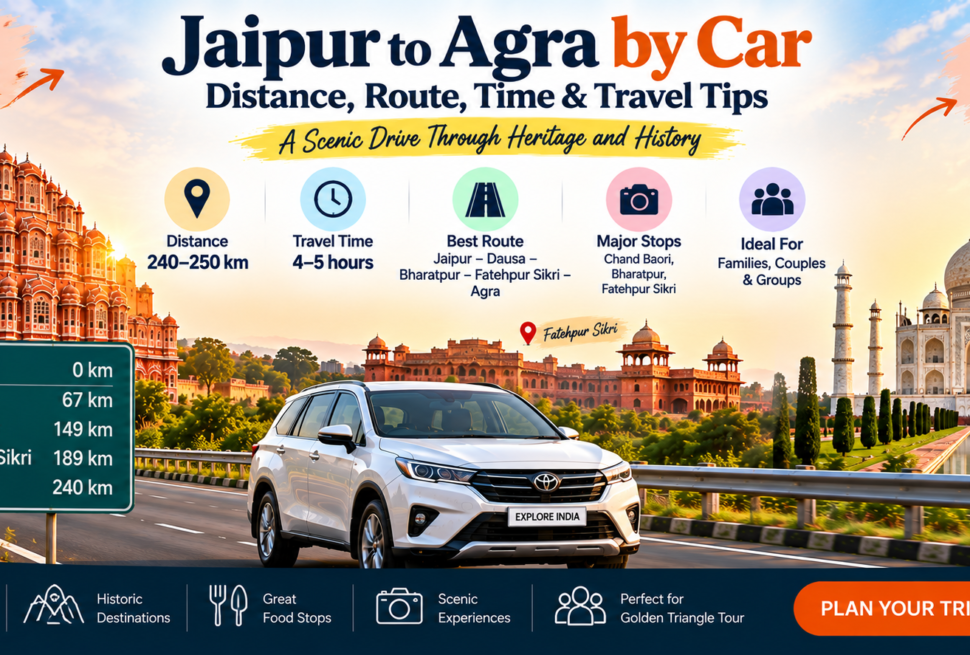
Day 4 – Agra to Jaipur
Visit the Taj Mahal in the morning, then travel to Jaipur.
Day 5 – Jaipur
Full-day Jaipur sightseeing.
Day 6 – Jaipur to Jodhpur
Travel to Jodhpur.
Day 7 – Jodhpur
Explore Mehrangarh Fort and the old city.
Day 8 – Jodhpur to Udaipur
Travel to Udaipur.
Day 9 – Udaipur
Explore City Palace and enjoy the lakeside atmosphere.
Day 10 – Departure
Continue to your airport or next destination.
The itinerary can be modified depending on your arrival and departure cities.
How to Make a Multi-City India Road Trip More Comfortable
A few simple choices can improve the experience considerably.
Start Early
Leaving early can help avoid some city traffic and provide more sightseeing time.
Don’t Overload the Schedule
Leave space for unexpected delays.
Choose Comfortable Hotels
After a long drive, a comfortable hotel makes a difference.
Carry Water
Keep drinking water available during long journeys.
Keep Important Items Accessible
Passports, phones, cameras, medication and documents should not be buried inside large suitcases.
Take Regular Breaks
Especially on long driving days.
Keep Offline Maps Available
Mobile connectivity can vary on some routes.
Multi-City Trip by Car: Self-Drive or Chauffeur?
| Factor | Self-Drive | Chauffeur-Driven |
|---|---|---|
| Flexibility | Very high | High |
| Driving responsibility | Traveller | Driver |
| Navigation | Traveller | Driver |
| Parking | Traveller | Driver |
| Long-distance comfort | Depends on driver | High |
| First-time India visitors | Requires confidence | Convenient |
| Privacy | Very high | High |
| Road-trip freedom | Excellent | Excellent |
| Best for | Experienced drivers | Most tourist itineraries |
For international tourists, a chauffeur-driven vehicle can make a multi-city itinerary simpler because they can focus on the destination rather than navigating unfamiliar roads.
Common Mistakes to Avoid
Mistake 1: Too Many Cities
More destinations don’t necessarily mean a better holiday.
Mistake 2: Ignoring Driving Time
Always consider actual road time, not just map distance.
Mistake 3: Choosing the Cheapest Vehicle
A low price is not useful if the vehicle is uncomfortable for your group.
Mistake 4: Not Checking Luggage Space
Make sure the car can comfortably accommodate everyone and their luggage.
Mistake 5: Forgetting Additional Charges
Ask about fuel, tolls, parking and driver expenses.
Mistake 6: No Rest Days
Long road trips require breaks.
Mistake 7: No Backup Plan
Keep some flexibility for traffic, weather and unexpected delays.
Frequently Asked Questions
What is the best way to plan a multi-city India trip by car?
Start by selecting a region, create a realistic route, estimate driving time, choose the right vehicle and then book hotels around your route.
How many cities should I visit in a 10-day India road trip?
Around four to six major destinations can be a reasonable starting point, depending on the distances between them. Avoid adding destinations simply to increase the number of cities.
Is a chauffeur-driven car better for an India road trip?
It can be particularly convenient for first-time visitors, international tourists, families and travellers covering multiple cities.
What car is best for a multi-city India trip?
A sedan can suit couples and small groups, while SUVs and MPVs are better suited to families and groups requiring additional space.
Is it cheaper to travel India by car or train?
It depends on the route, group size, vehicle type and travel style. A train may be economical for certain long-distance journeys, while a private car can provide door-to-door convenience and sightseeing flexibility.
Should I book a car for the entire trip?
Not necessarily. If you are spending several days in one city, you may only need a car for airport transfers and sightseeing days. For continuous multi-city travel, keeping the same vehicle can be more convenient.
What expenses should I include in my road-trip budget?
Consider vehicle rental, fuel, tolls, parking, driver allowance, taxes, accommodation, meals and attraction tickets.
Can I take a rental car between different states in India?
Many outstation rental services allow interstate travel, but the applicable permits, taxes and rental conditions should be confirmed with the operator before departure.
How much luggage should I take?
Pack according to your vehicle’s actual luggage capacity. Avoid carrying unnecessary large bags on a multi-city road trip.
Final Thoughts
Planning a multi-city India trip by car requires more than simply connecting destinations on Google Maps. The best road trips balance driving time, sightseeing, accommodation, comfort and flexibility.
Start by choosing a region and then build a logical route. Avoid unnecessary backtracking and don’t try to visit too many cities in a short period.
Choose your vehicle according to the number of passengers and luggage. A sedan may be ideal for couples, an SUV can work well for families and small groups, while a Tempo Traveller can make group travel easier.
Most importantly, remember that the journey itself is part of your India experience. Give yourself enough time to stop, explore, eat, photograph the landscape and enjoy the places between major destinations.
Whether you choose the classic Delhi–Agra–Jaipur Golden Triangle, an extended Rajasthan circuit, a Kerala road trip or another regional itinerary, careful planning can turn a simple car rental into an unforgettable India road adventure.